
Cozumel is one of the preeminent diving locations in the world. It has incredibly clear waters, colorful sponge based fauna, a range of interesting sea life and insanely large and complex coral formations you can swim through and around. These formations are part of the Mesoamerican Reef, which is the second longest barrier reef in the world and over 200 million years old.
Unfortunately, most of the hard coral in Cozumel is dead. It has been hit with series of tragic events since the early 1980s:
- White Band Disease wiped out as much as 90% of the elkhorn and staghorn corals, two of the most important reef-building hard corals in the Caribbean, in the early 1980s.
- An unknown affliction wiped out most of the long-spine sea urchins in the Caribbean by the end of 1984. These are the primary animals that feed on sea algae. When algae overgrow, they smother juvenile corals and stop reef recovery.
- Overfishing of key herbivore fish species in nearby areas also contributed to higher algae growth.
- Extensive damage from Hurricane Gilbert in 1988. Additional damage occurred from hurricanes Wilma and Emily in 2005.
- Arrival of Stony Coral Tissue Loss Disease in 2018 that spread rapidly. By July 2019, there was a 46% average loss in coral cover across study reefs, with some sites experiencing up to an 80% loss.
- Nutrient enrichment and sediment from coastal development and poor wastewater treatment promote algal growth and stress corals, making reefs more susceptible to bleaching and disease. Cozumel has grown from 23,000 people in 1980 to over 120,00 people in 2025. Also, Cozumel is now the world’s 4th busiest cruise ship port with over 4.5 million passengers in 2024.
- Add to that the additional stress from some of the global coral bleaching events in recent years.
With all that history, I decided to make weekly trips over to Cozumel from my three month base in Playa del Carmen to volunteer at The Cozumel Coral Reef Restoration Program: https://www.ccrrp.mx/. While I’m not sure how much this small project can really do to restore Cozumel’s extensive coral damage, it was still a rewarding experience.
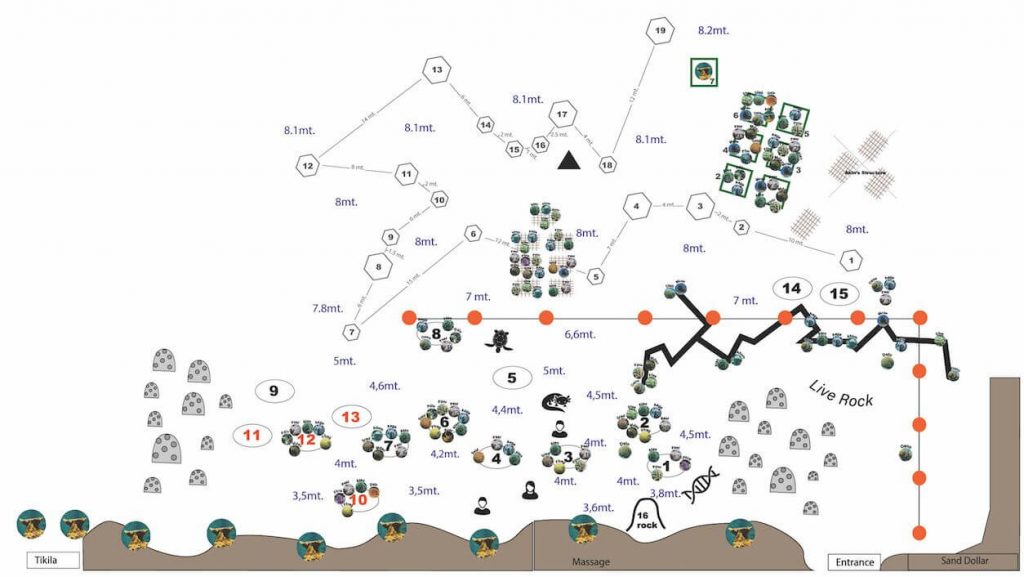
They have set up a series of platforms to grow coral on in a small area away from the formal marine park.
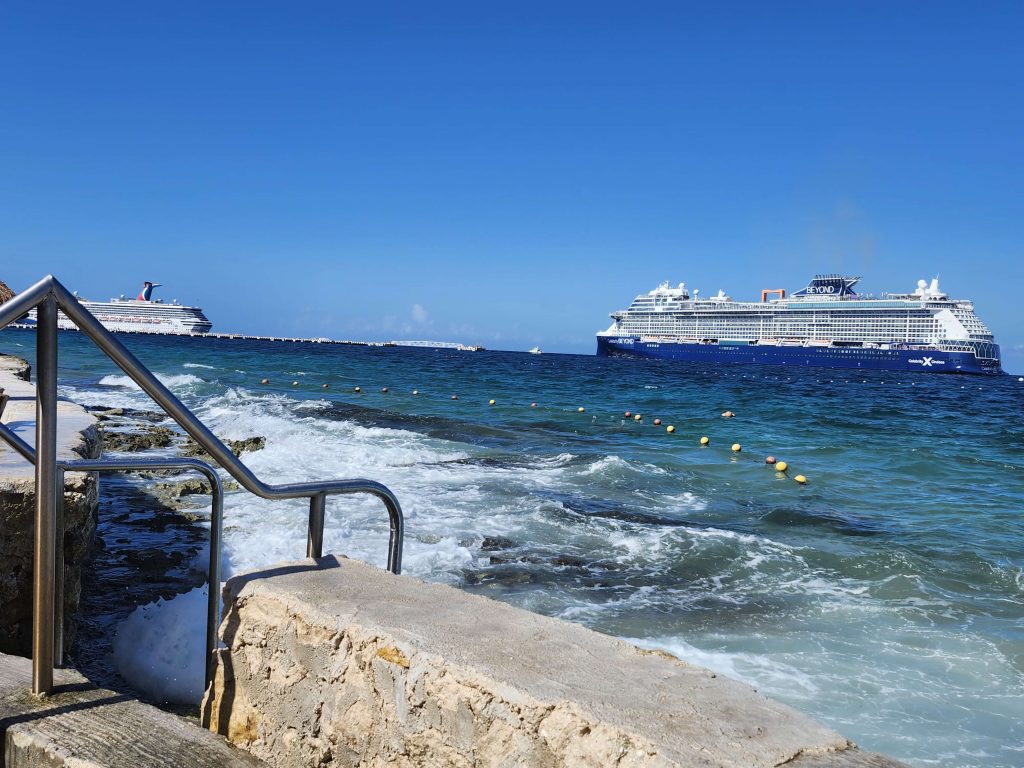
Funnily enough it’s located in the shadow of one of the largest cruise ship pier complexes in Cozumel.
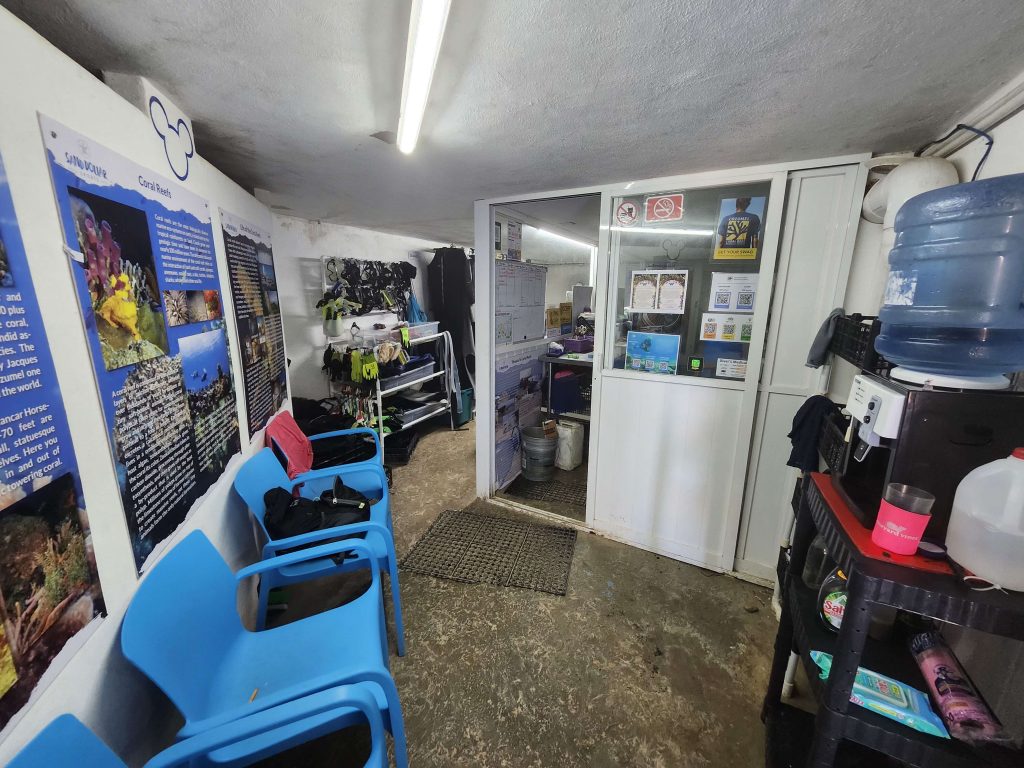
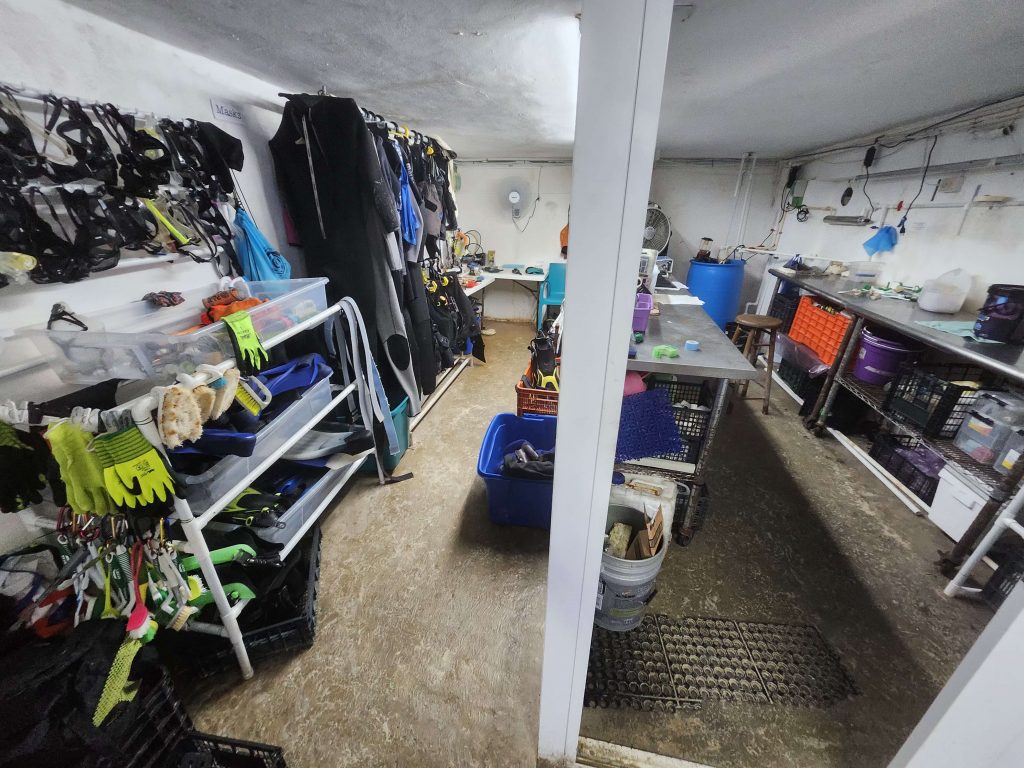
There’s a very simple room where the gear and their modest lab work is located.
Here, Dr German is showing some new volunteers how to clean coral, both in an open area…
…and on one of the formal platforms.
Most of the platforms are in the open.
And a few have covers over them to reduce the heat stress on the coral during the hotter summer months.
Here is one platform with a lot of healthy coral after a cleaning session.
A few fish are inspecting a newly cleaned area in another platform to make sure we did a good job.
A beautiful sea fan growing in the open area near one of the platforms.

One day a couple of us went out to one of the open areas to clean an area that hadn’t been worked on in a while. It was pretty well covered in algae when we first got there.
Here’s a video of me trying to clean with one hand and hold the camera with the other as a large parrotfish swam by looking for scraps.
That section was much cleaner afterward.
Someone took a picture of me in action on this project.
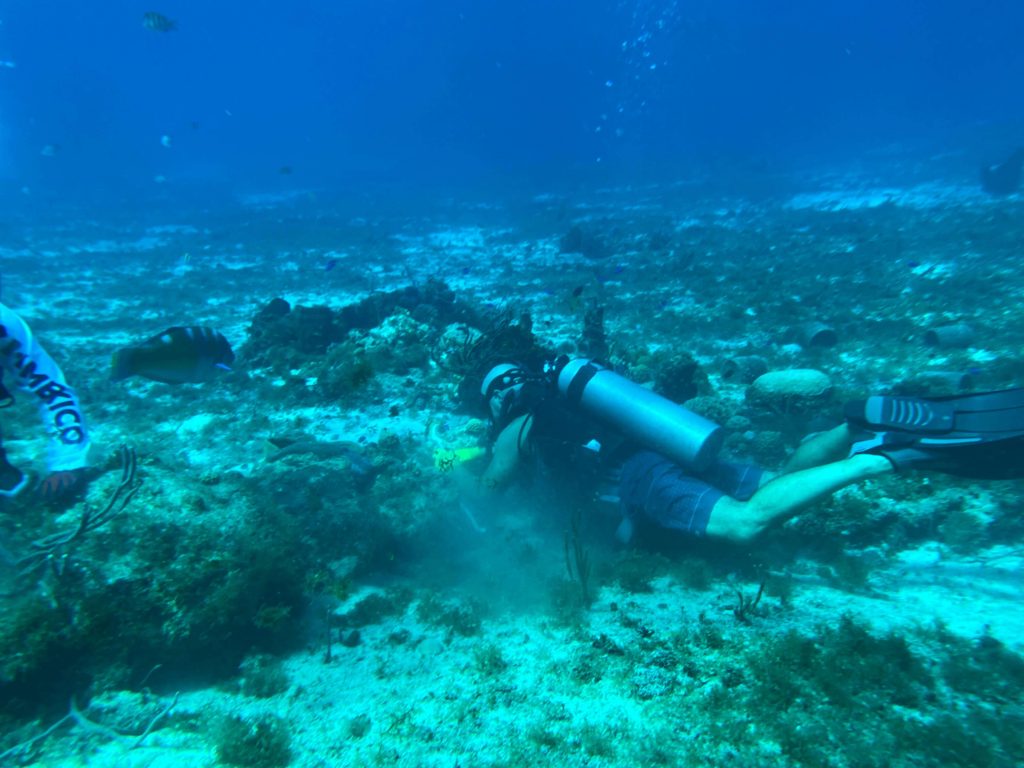
One of the nicest aspect of doing this is all the small sea life that hangs around the platforms. Here’s a tiny shrimp that I worked hard to avoid in my cleaning.
On another platform, I tried not to disturb a small arrow crab.
A pretty blue cowfish swims past.
A puffer fish swims out from under a platform to check out what all the fuss is about.
A young moray eel is disturbed by the cleaning activity.
A burrfish meanders past us.
A juvenile ray is disturbed by my swimming near it.
Diving in Cozumel
While there is the long term issue of the loss of hard corals in Cozumel, it is still a spectacular place to dive. The millions of years old coral structures still present a wonderful backdrop to the crystal clear waters, and as well as opportunities for really nice, peaceful swim through experiences.
The primary seascapes are now made up of large, diverse, colorful sponges and the unfortunate huge overgrowths of algae. While it is sad to see the absence of hard coral, they are still beautiful places to dive around.
Some sections still have waves of soft coral swaying gently in the current.
It was eagle ray season the last few weeks I was there. In the last ten minutes of my last dive we saw two magnificent eagle rays floating through the water followed by a young reef shark.
Most of the sharks in Cozumel are the really chilled out and harmless nurse sharks. They are completely unbothered by any wayward scuba divers swimming near them.
One of the most unique creatures only found in Cozumel is the apply named splendid toadfish. They just hang out under rocks waiting for prey to swim by.
And, of course, there is a wide array of other types of sealife in Cozumel.
The fireworm gets its name because if you touch it the little fuzzy parts on its skin come off on your skin and it will burn for a few hours. I’ve been told it’s not a pleasant experience.
Cenotes
The Yucaton Peninsula is built upon a limestone base with huge cavities where water flows through. It is one of the best cave diving places in the world. Cenotes are where these underground water structures have distinct open entrances. Diving in cenotes is a unique experience. In most cases large sections are pitch black and it’s just you, your dive guide, and your light drifting through these surreal waterscapes.
Zapote Cenote
Zapote Cenote is known for it’s wonderfully unique structures known as Hells Bells. They are are speleothems (a geological formation made by mineral deposits that accumulate over time in natural caves) that appear to have formed through incompletely understood complex interplays between water of the cave, microorganisms living in the cave, and the surface of the Hells Bells. They are in caverns over 30 meters (100 feet) down in pitch black darkness. As you can see from these videos, diving here is a pretty cool experience.
One of the other nice things about Zapote is that the area around it is also very well developed. Most other cenotes are in pretty rustic environments.
Here’s the main entrance where you pay to get in.

The nice little walk to the toilets.

The well developed actual entrance to the cenote.

The Pit Cenote
One of the reasons it’s called The Pit is its very steep entrance which you have to carefully navigate down while wearing your full dive gear.

But the real reason for its name is that it’s a very deep sinkhole with clear visibility and, on a sunny day, lazer like lightbeams that pierce deep into its interior. It also has a mesmerizing hydrogen sulfide cloud at about 25 meters and incredible stalactites and ancient rock formations.
The contrast of the stalactites and the divers’ bubbles in the light shaft from the top make a wonderful scene.
Everything becomes murky as you swim through the cloud of hydrogen sulfide.
There’s some very small remnants of an ancient campfire at over 30 meters deep.
There are numerous small caves to swim around with nice formations inside.
Dreamgate Cenote
Dreamgate is known for its crystal clear waters and amazing diversity of stalactites and stalagmites. Because of this, it was the one cenote in Mexico where the David Attenborough documentary Planet Earth decided to film. My lighting is not as good as theirs, but you can still get a sense of how unique this place is.
Maravilla Cenote
Maravilla Cenote is a one trick wonder. There really isn’t much to it except for, on a sunny day, the sublime light rays which beam into the crystal waters.
Here’s the easy access entrance to the cenote.

Following my dive guide down through this shaft of light with the free divers practicing above us was a wonderful experience.
As we approached the maximum depth of the dive there was a hydrogen sulfate cloud below us where the shadows from our bodies could dance upon.